The KWYAB Standard for Personal Tech
In the current market, the personal electronics industry is driven by a relentless cycle of incremental updates and flashy keynotes. Brands often prioritize aesthetic trends and theoretical specs—like megapixels or peak brightness—while ignoring the fundamental metrics of daily reliability and long-term hardware integrity. Our approach to personal tech rejects this superficial narrative. We focus on how these devices integrate into your life under real-world conditions, emphasizing battery longevity, structural durability, and functional efficiency.
Whether you are selecting a primary communication device, optimizing your mobile workflow with a tablet, or enhancing your environment with high-fidelity audio, every piece of tech must justify its place in your pocket or bag. We analyze the entire mobile ecosystem to ensure that your investment translates into a seamless, high-performance experience that lasts beyond the next product launch.
Real-World Utility Over Industry Hype
Our evaluation methodology is designed to expose the gap between a spec sheet and actual user experience. When we assess personal technology, we look for the engineering truths that define long-term satisfaction:
- Sustained Battery Health vs. Day-One Specs: We look past initial capacity to evaluate power management efficiency and how hardware holds up after hundreds of charge cycles.
- Build Quality and Material Integrity: We move beyond “premium feels” to inspect chassis rigidity, ingress protection (IP ratings), and the repairability of the internal architecture.
- Ecosystem Cohesion: No device is an island. We evaluate how wearables, tablets, and accessories communicate, ensuring that “smart” features actually save time rather than creating friction.
- Software Lifecycle and Support: Hardware is only as good as the code running it. We monitor manufacturer track records for security patches and OS stability over multi-year periods.
Defining Your Personal Digital Ecosystem
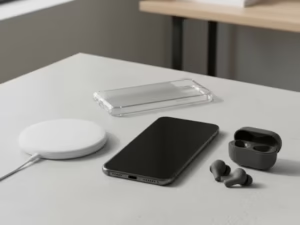
Personal tech covers the most intimate tools in your digital arsenal. Smartphones act as the central hub, wearables monitor your physiological performance, audio gear defines your focus, and tablets bridge the gap between consumption and creation. By applying our rigorous, anti-PR testing standards across these diverse categories, we help you navigate a saturated market.
We do not care about “world-first” gimmicks or aggressive influencer campaigns unless they are backed by tangible engineering excellence. If a flagship device throttles its processor during basic multitasking, or if a pair of headphones relies on software EQ to mask poor driver quality, we highlight those failures. Your personal tech should be a reliable extension of your capabilities, not a fragile accessory. Explore our technical evaluations to find the exact tools required for a robust and uncompromising mobile life.