Reader Supported: We may earn a commission when you buy through links on our site.
Logo of the Website Know What You Are Buying
  • Hardware
    • Laptops & Desktops
    • .st0{fill-rule:evenodd;clip-rule:evenodd;} Monitors & Displays
    • PC Components
    • Peripherals & Connectivity
    • Storage & Backup
    Hover over a category to see top picks
  • Gaming
    • .st0{fill-rule:evenodd;clip-rule:evenodd;}Console Gaming
    • .cls-1{fill-rule:evenodd;}gaming-pcPC Gaming
    • Handheld & Mobile
    • Streaming & Audio Gear
    • Vr & Ar Headsets
    Hover over a category to see top picks
  • Personal Tech
    • .st0{fill-rule:evenodd;clip-rule:evenodd;}Smartphones & Accessories
    • .cls-1{fill-rule:evenodd;}earbudsHeadphones & Audio
    • .cls-1{fill-rule:evenodd;}camera-droneCameras & Drones
    • Smartwatches & Wearables
    • .st0{fill:#000000;} Tablets & E Readers
    Hover over a category to see top picks
  • Smart Home
    • Speakers & Displays
    • Security & Surveillance
    • Smart Appliances
    • Lighting & Ambience
    • Networking & Wifi
    Hover over a category to see top picks
  • Software
    • Antivirus & Privacy
    • VPN & Online Security
    • Web Hosting & Cloud
    • AI Tools & Subscriptions
    • .st0{fill:#000000;} Creative & Productivity
    Hover over a category to see top picks
  • Workspace
    • Standing Desks
    • Ergonomic Seating
    • Monitor Arms & Stands
    • Office Lighting
    • Hybrid Work Gear
    Hover over a category to see top picks
  • Power
    • Portable Power Stations
    • Solar Panels & Kits
    • Smart Energy Monitors
    • Electric Mobility
    • Charging & Power Banks
    Hover over a category to see top picks
  1. Home
  2. Power & Eco-Solutions

Power & Eco-Solutions

Energy independence shouldn’t rely on inflated capacity claims or cheap battery cells that degrade after a year. We cut through the greenwashing and spec-sheet hype to bring you empirical data on the entire power ecosystem, from battery chemistry to solar yield. Build a resilient, off-grid or backup setup based on real-world sustained output, not empty corporate promises.

Refine by Topic

Charging & Power Banks

Charging & Power Banks

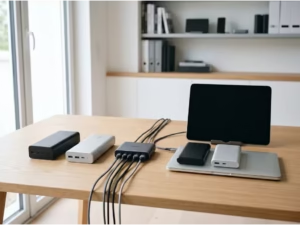
Don't rely on cheap, gas-station power banks that take forever to charge...

Electric Mobility

Electric Mobility

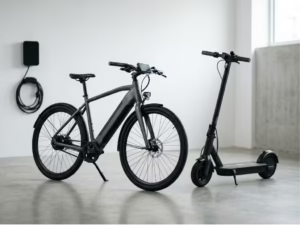
The e-bike and scooter market is rife with exaggerated range claims and...

Portable Power Stations

Portable Power Stations

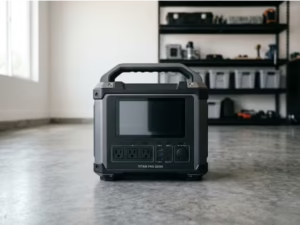
The portable power station market is notorious for overpromising watt-hours and under-delivering...

Smart Energy Monitors

Smart Energy Monitors

Smart home dashboards are useless if the underlying CT clamps are feeding...

Solar Panels & Kits

Solar Panels & Kits

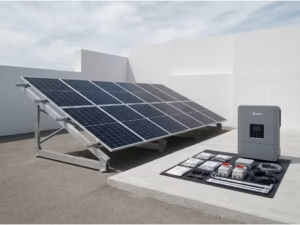
Don't let lab-generated "Standard Test Conditions" deceive you. We evaluate portable and...

We are gathering data

Our experts are currently working on content for this section. Check out our latest global analysis below.

Latest Global Coverage

Asus ROG Zephyrus G14 Review: Still the King of Portable Gaming

Asus ROG Zephyrus G14 Review: Still the King of Portable Gaming

The Asus ROG Zephyrus G14 is the ultimate 14-inch premium laptop, blending desktop-level gaming performance with an ultralight CNC-milled chassis and a stunning OLED display. It perfectly balances raw power with extreme portability for both gamers and creators on the move.

Read analysis →

The KWYAB Standard for Power & Eco-Solutions

The consumer power market is flooded with hypothetical maximums and deceptive marketing. Brands push massive wattage ratings and theoretical solar yields, completely ignoring how these devices perform under sustained loads or real-world weather conditions. Our approach to power and eco-solutions fundamentally rejects this PR-driven narrative. We focus strictly on true usable capacity, continuous inverter output, and long-term battery cycle life.

Whether you are outfitting an RV, preparing a home emergency backup system, or optimizing your daily energy consumption, your power gear must be uncompromisingly reliable. A single weak link—be it an inefficient solar charge controller or a power station that overheats and shuts down—can leave you in the dark when you need it most. We analyze the entire energy ecosystem to ensure you invest in hardware that actually delivers the juice.

Real-World Output Over Marketing Buzz

Our testing methodology is designed to break through the illusions created by laboratory test conditions. When we evaluate power equipment, we look for the chemical and electrical truths that dictate daily use:

  • Usable Capacity vs. Claimed Watt-Hours: Inverters consume power to operate. We measure the actual watt-hours you get out of the AC outlets, exposing the efficiency losses that most manufacturers try to hide.
  • Battery Chemistry and Cycle Life: We prioritize LiFePO4 (Lithium Iron Phosphate) over outdated NMC (Nickel Manganese Cobalt) chemistries, ensuring your investment survives thousands of charge cycles without catching fire or rapidly degrading.
  • Surge and Sustained Output: Powering a laptop is easy; starting a refrigerator compressor is not. We test inverters against heavy inductive loads to see if they can handle their advertised surge ratings without tripping.
  • Thermal Management: Moving high currents generates massive heat. We monitor internal temperatures and fan curves to ensure continuous safe operation during heavy discharge or fast charging.

Building a Resilient Energy Foundation

The modern power ecosystem encompasses a vast array of interconnected devices. Portable stations store the energy, solar panels generate it, monitors track your consumption, mobility devices use it, and power banks keep your daily carry alive. By applying our rigorous, anti-BS testing standards across all these categories, we help you navigate the noise.

We do not care about rugged-looking plastic bumpers or flashy LCD screens if the internal inverter is garbage. If a solar panel produces a fraction of its rated wattage under a clear sky, or if a power bank throttles its charging speed after five minutes, we will call it out. Your power gear needs to work relentlessly under pressure. Explore our comprehensive evaluations to find the exact tools you need to build an uncompromising energy setup.

Frequently Asked Questions

What is the difference between starting watts and running watts?

Running watts indicate the continuous power required to keep an appliance on, while starting (or surge) watts represent the brief, massive spike in power needed to start motor-driven appliances like refrigerators or AC units. Your power source must be able to handle both.

Why is LiFePO4 better than standard lithium-ion?

LiFePO4 (Lithium Iron Phosphate) is far safer and much more durable than standard NMC lithium-ion. While slightly heavier, LiFePO4 batteries typically offer 3,000 to 6,000 charge cycles before degrading to 80% capacity, compared to just 500-800 cycles for NMC.

Do solar panels actually produce their rated wattage?

Rarely. Solar panels are rated under Standard Test Conditions (STC) in a laboratory. In the real world, factors like atmospheric density, angle of the sun, and panel temperature mean you should realistically expect about 70% to 85% of the advertised wattage on a good day.

What is an MPPT charge controller?

MPPT (Maximum Power Point Tracking) is a highly efficient algorithm used in modern power stations and solar setups. It constantly adjusts the voltage and current coming from the solar panels to extract the absolute maximum energy possible, vastly outperforming older PWM controllers.

How do I calculate what size power station I need?

List all the devices you want to run simultaneously to find your required inverter output (watts). Then, estimate how many hours you need to run them to find your required capacity (watt-hours). Always add a 20% buffer for inverter inefficiency.

Is it safe to leave a power station plugged in all the time?

Most modern power stations with advanced BMS (Battery Management Systems) protect against overcharging. However, for maximum longevity (especially with NMC batteries), it is best to store them at around 50-80% capacity if they won’t be used for several months as a backup.

What causes a power inverter to shut down?

Inverters typically shut down due to three reasons: drawing more continuous power than it is rated for, a surge spike from a heavy motor that exceeds the surge limit, or thermal throttling because the internal components have overheated.

How do you test the reliability of eco-solutions?

We test power and eco-solutions by running sustained, real-world loads (like space heaters or fridges) to deplete batteries from 100% to 0%. We monitor thermal performance, recharge speeds, and inverter stability to ensure the product performs reliably outside of a controlled PR environment.

knowwhatyouarebuying.com

We spend hundreds of hours conducting hands-on tests and data-driven analysis to help you make confident purchasing decisions. Our reviews are 100% independent and reader-supported.

100% Independent
Data-Driven Reviews
Reader Supported

Categories

  • Computing & Hardware
  • Gaming & Streaming
  • Personal Tech
  • Power & Eco-Solutions
  • Smart Home
  • Software Services
  • Workspace & Ergonomics

Legal

  • Legal Notice
  • Privacy Policy
  • Cookie Policy
  • Affiliate Disclosure

About KWYAB

  • About Us
  • How We Test
  • Editorial Guidelines
  • Contact Us
contact@knowwhatyouarebuying.com

Affiliate Disclosure: KnowWhatYouAreBuying is reader-supported. When you buy through links on our site, we may earn an affiliate commission at no extra cost to you. This supports our independent research and testing process.

© 2026 knowwhatyouarebuying.com. All rights reserved. Designed for smarter decisions.

Global:
ENES

We value your privacy

We use tracking technologies to improve your experience, perform analytics, and support our independent research. You can choose to accept all or manage your preferences.

Privacy Cookies Legal Notice

Manage Cookie Preferences

Strictly Necessary

Required for the website to function. Cannot be disabled.

Always Active

Analytics

Help us understand how visitors interact with the site.

Marketing & Affiliation

Used to track conversions from affiliate links to support our work.